Home» picture
CAAS and IFPRI Unveil Reports on China's Agricultural Sector and the Future of Food Systems
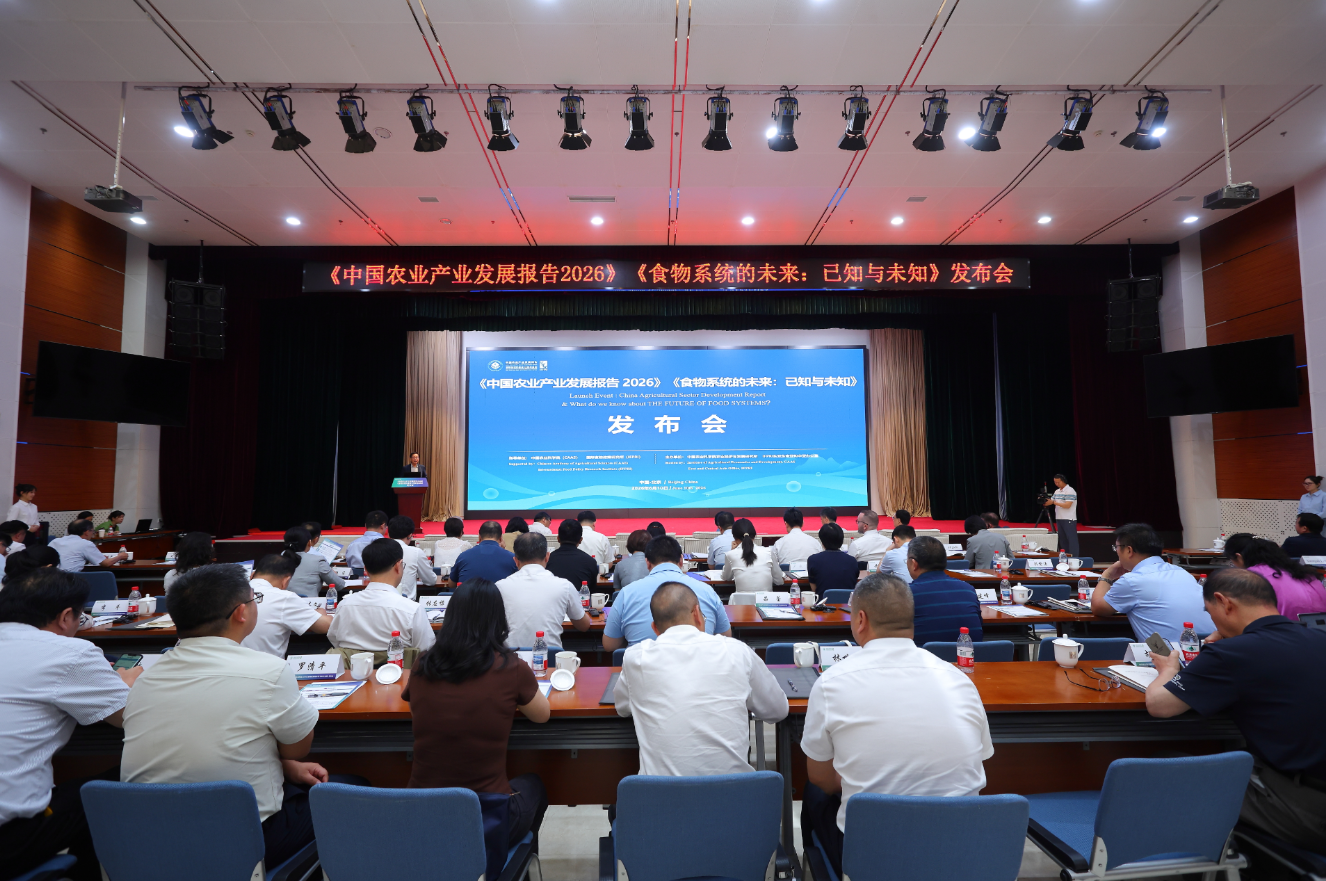
Beijing, 10 June 2026 — The Chinese Academy of Agricultural Sciences (CAAS) and the International Food Policy Research Institute (IFPRI) hosted the launch of two major publications examining the forces reshaping agriculture and food systems in China and beyond: China Agricultural Sector Development Report 2026 and What do we know about THE FUTURE OF FOOD SYSTEMS?
The conference, held under the theme “15th Five-Year Plan Opening Year: Structural Transformation and High-Quality Trade”, was co-chaired by Ye Yujiang, Vice President of CAAS, and Kevin Chen, Senior Research Fellow at IFPRI.
Opening the event, Yang Zhenhai, Secretary of the CPC Leading Group of CAAS, noted that China made historic strides in agricultural and rural development during the 14th Five-Year Plan period (2021-2025), including raising annual grain output above 700 million tonnes. Yet rural China remains the biggest hurdle if the country wants to be modernized. In this context, the two reports represent think-tank insights that offer a global perspective and evidence to inform policy design aimed at ramping up agricultural and rural modernization during the 15th Five-Year Plan period (2026-2030).
In a video address, IFPRI Director General Johan Swinnen highlighted the growing obstacles confronting food systems worldwide, including climate change and economic volatility. He praised the two publications as they showcased the vital role of research and partnership in meeting these challenges effectively, and reaffirmed IFPRI’s commitment to continue working with CAAS to promote sustainable and equitable food systems in China and across the world.
Presented by Hu Xiangdong, Director General of the Institute of Agricultural Economics and Development at CAAS, China Agricultural Sector Development Report 2026 outlined key trends expected to shape China’s agricultural sector during the 15th Five-Year Plan Period, namely changing consumer demand, advances in mechanization, and a more coordinated relationship between domestic production and international trade.
A new phase of transformation
On food consumption and nutrition, demographic aging, rising incomes, and continued urbanization are expected to accelerate shifts in dietary patterns. Staple food consumption is projected to become increasingly quality-oriented rather than volume-driven. Among animal-source foods, pork demand is getting softer, while poultry consumption will go up. Demand for edible oils is likely to remain on an upward trajectory. At the same time, milk and vegetable consumption remain around half of the targets outlined in China Food and Nutrition Development Guidelines, highlighting the need for both stronger production incentives and consumer education.
The report is innovative in that it introduces a new governance framework for food-system transformation centered on nutrition and health outcomes. The framework identifies processors, distributors and other midstream actors as strategic leverage points capable of influencing both production decisions and consumption outcomes. By strengthening these links, the report argues, market demand can become a more effective driver of supply-side adjustment and agricultural upgrading.
Mechanization as a driver of productivity
The report places agricultural mechanization within the broader framework of developing new productive forces in agriculture. It argues that machinery is no longer simply replacing animal power and labor; increasingly, it serves as a platform through which improved varieties, better-equipped farmland, advanced agronomic approaches, and enabling systems can work in tandem.
Quantitative analysis suggests that further mechanization could unlock grain production gains measured in tens of millions of tonnes. Specialized agricultural service providers are seen as particularly effective pathways for boosting productivity. Future policy support, the report argues, should shift from subsidizing equipment purchases toward strengthening service systems, addressing persistent gaps in hilly and mountainous regions and in post-harvest operations such as grain drying, and increasing smart farming scenarios.
Rethinking agricultural trade
The report projects that China's agricultural imports will continue to reflect strong demand for feed grains, livestock, and aquatic products, while identifying soybean and beef as commodities warranting particular attention.
On the export side, it argues that future competitiveness will depend less on expanding volumes than on capturing greater value. The report calls for a stronger focus on product differentiation, processing, cold-chain development and brand building, particularly in selected fruits, vegetables, and aquatic products. Such an approach, it suggests, would help advance a more sophisticated trade structure characterized by both higher-quality imports and higher-value exports.
Food systems under growing strain
The second publication, What do we know about THE FUTURE OF FOOD SYSTEMS?, was presented by IFPRI Senior Research Fellow Karl Pauw. Co-authored by more than 100 experts from around the world, including Chinese contributors, the volume examines the complex interactions shaping food systems across multiple domains in decades ahead.
Its findings suggest that resource constraints are likely to intensify, while extreme weather events may become more frequent. Poverty is expected to become increasingly concentrated among vulnerable populations, and gaps in access to healthy diets could widen. At the same time, innovation, proactive policy, and international trade offer powerful tools for addressing these challenges.
The publication includes a dedicated chapter on China, highlighting the country's transition from a primary focus on food security toward broader objectives encompassing nutrition and dietary quality. It identifies technological innovation and deeper integration with global markets as key drivers of future progress, particularly under growing constraints on arable land and water resources. Structural transformation within agriculture and the expansion of agricultural service providers are also expected to play increasingly important roles.
The launch event featured commentary from leading Chinese experts, including Guo Wei, former Deputy Secretary-General of the State Council and member of the Committee on Agriculture and Rural Affairs of the Chinese People's Political Consultative Conference; Zhao Changbao, Director General of the Research Center for Rural Economy, Ministry of Agriculture and Rural Affairs; Du Zhixiong, Secretary of the CPC Committee of the Institute of Rural Development at the Chinese Academy of Social Sciences; Huang Jikun, Dean of the School of Advanced Agricultural Sciences, Peking University; and Ye Xingqing, former Director General of the Department of Rural Economy at the Development Research Center of the State Council.
The conference brought together representatives from the National Development and Reform Commission and the Ministry of Agriculture and Rural Affairs of China, CAAS and provincial agricultural academies, diplomatic missions in China, China offices of international organizations, universities, and media outlets. Proceedings were broadcast globally in both Chinese and English.
Quick Links